NutriVie Sante
  • HOME
  • ABOUT
    • Media
  • EXPERTISE
    • Eating Disorders
      • Anorexia Nervosa
      • Avoidant Restrictive Food Intake Disorder
      • Binge-eating Disorder
      • Bulimia Nervosa
      • Orthorexia
      • Bigorexia
      • Other Specified Feeding or Eating Disorder
      • Weight Issues / Obesity
      • Unhealthy relationship with food
      • Negative body image
    • Disordered eating
    • Chronic illnesses and other motives
  • SERVICES
    • Individual Counselling
    • Nutrition Workshops
    • Corporate conferences
  • CONTACT
  • BLOG
  • RECIPES
  • FR
  • Menu Menu
  • Facebook
  • Instagram
Eating disorders, Healthy relationship with food, Intuitive eating, MIndful eating

How to Navigate Holiday Eating When You Have a Difficult Relationship With Food
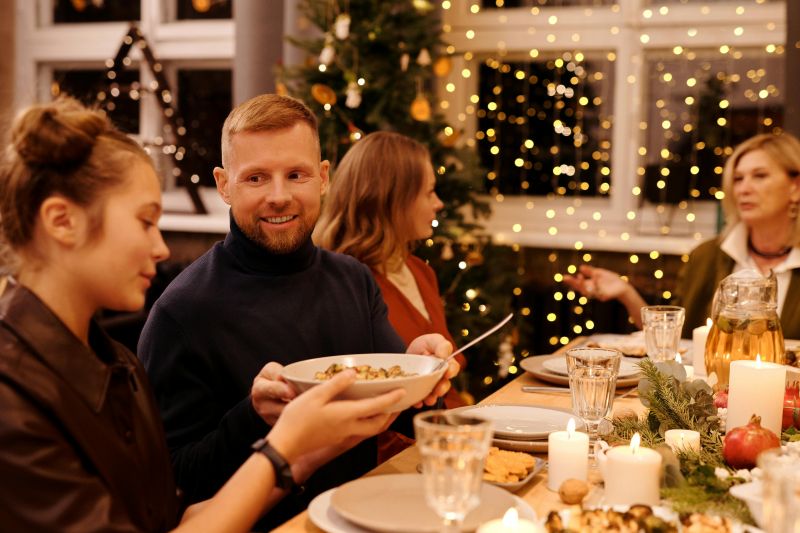
As the holidays are approaching, this season can feel overwhelming. For those of you with a complicated relationship with food and your body, the family gatherings, heavier meals and more indoor time due to the cold weather can undoubtedly trigger more emotional eating, intrusive thoughts about body image and food anxiety.

If this resonates with you, please know that all those feelings are completely normal and valid. You are not alone!

The holidays can be beautiful, chaotic, nostalgic, stressful, and daunting all at once. And when you’re trying to heal your relationship with food, that mix can feel even more intense.

This guide will provide you with tips and tricks to help you navigate holiday eating, emotional eating and holiday food guilt while giving yourself self-compassion to help you feel better physically, mentally and emotionally.

1. Remember: Holiday Eating Is Meant to Be Different

With all the work holiday parties, family meals, Christmas and New year’s gatherings can certainly throw off your regular eating schedule. In addition, short daylight and cold winter gatherings in Montreal can make emotional eating more common. The meals can also be denser in terms of calories, fat and sugar. Undoubtedly, if you have food rules or fear of over-eating, this can quite triggering.

To help you with food guilt, anxiety and be more connected with your body’s cues, try reminding yourself of a few things:

  • Food has many functions It’s not just meant to bring you nutrients. Food brings comfort, connects people with each other and helps us celebrate traditions.
  • A few festive meals won’t impact your health or your weight. Try to look at the bigger picture: it might be 4-5 festive meals during the holidays out of at least 90 meals throughout the month (considering you eat at least 3 meals per day). That represents 5% of the times your usual food intake. Instead, try to look at the other 95% of the times you eat regular nutritious meals.
  • When we are connected with our body, our body will adjust itself naturally after eating heavier meals. Your body is very smart. For instance, you might feel less hungry in the next coming days and the cravings might also be different. For example: you could be gravitating towards lighter meals naturally.

2. Let Go of the “Good vs. Bad” mentality

Categorizing food as good and bad will make the “good” foods mandatory and thus they become more of a chore or punishment for you to eat. On the other hand, the “bad” foods will be put on a pedestal and you’ll want to gravitate towards them just because they are forbidden. This could fuel restrict-binge cycles and food guilt.

Yes, undoubtedly, there are some foods which are more nutritious than others. But again, your body is smart. If you allow yourself all foods and are connected to your body, you will see that most of the times you will actually gravitate towards the healthier foods because they make you feel better physically.

So, before your holiday gatherings, try to eat your meals and snacks before your festive meals. This will help prevent you from getting to the meals starving and decrease the risk of losing control with food. Let go of the diet mentality and try to also enjoy your meal without guilt and savour the moment with your loved ones.

3. Build a Plate That Feels Nourishing and Satisfying

In front of a festive table with all kinds of different dishes, we might often plate food mindlessly. Sometimes, some dishes might not be foods we actually enjoy but foods that we portion on auto-pilot mode on our plate.

Try to practice some mindful eating techniques during this holiday season. Here are some questions you can ask yourself to check in with your body as you are plating your food:

  • Which dishes look appealing and would I like to try?
  • What foods do I want to try for comfort and connection?
  • What is my level of hunger right now?
  • How do I want to feel after eating? Is it worth it to continue eating knowing that I will feel too full?
  • Do I want to save some for later when I’ll have more room in my stomach?

Remember, there’s no right or wrong answer. A balanced holiday plate is based on your body’s cues and needs and try not to compare your plate with others in terms of quantity and quality. Your body, your needs! And everyone has different needs and preferences.

Also, if more emphasis is placed on satisfying meals, you might be surprised to see that the urge to over-eat can be less present.

 4. Protect Yourself From Body & Diet Talk

During holiday gatherings, there are often a host of comments about food and body image. Often, those comments can be well intentioned but are in fact quite damaging for your relationship with food and your body. For instance, you could hear:

  • “That’s a lot of food on your plate! Are you going to be able to finish it all?”
  • “I’ll have to go on a diet after this meal.”
  • “I’ll need to go to the gym tomorrow to burn off the excess calories.”

Those types of comments can actually just reinforce the restrict-binge-food guilt cycle.

To set some boundaries and shield yourself, you can respond with:

  • “I usually don’t talk about diet and body image. Let’s change the subject.”
  • “I am aware of my body’s needs and I am honouring my body cues.”
  • “Food is so much more than just calories. Let’s also focus on the pleasure of eating and bonding with each other over a festive meal.”

5. Prepare for Your Personal Triggers

Each individual can have their own personal food triggers and emotional stressors. Try to identify what are your biggest triggers and make a list of different coping mechanisms or boundaries that you can put to help you navigate those stressors.

Here are some examples:

  • Trigger: Some specific fear foods that could be more anxiety-provoking: appetizers, richer foods at meal times, desserts, chocolates, etc.

Coping mechanism: may be try asking friends/families what they plan to serve at the meal ahead of time. Ensure that there are some safe foods and respect your boundaries if you feel too triggered to eat the fear foods. You could even bring a dish that you feel comfortable eating.

  • Trigger: lack of food structure: not eating at regular hours

Coping mechanism: You can maintain your regular routine when it comes to your meals and snacks to feel more grounded.

  • Trigger: unpleasant comments from family about food and body image

Coping mechanism: have a supportive family member you can talk to or a friend you can text for support.

Coming up with a plan often makes a big difference.


While many people in your surroundings can look forward to the holiday season, it is valid for you to dread it if food and body image feel stressful. You deserve a quiet and peaceful holiday season that meet all you emotional, mental and physical needs.

If you need extra support to help you navigate your food and body image struggles, please reach out to a dietitian, therapist or a trusted person from your circle. A great free resource is the ANEB’s helpline:

Seeking help is a sign of courage and can make a big difference. Feel free to contact us if you would like to chat and see how we can help you.


You’re not navigating this alone.
You deserve peace, warmth, and connection — in every season, but especially now.

December 9, 2025/by Votre nutritionniste Jaimie Yue
Share this entry
  • Share on Facebook
  • Share on Twitter
  • Share on WhatsApp
  • Share on Pinterest
  • Share on LinkedIn
  • Share on Tumblr
  • Share on Vk
  • Share on Reddit
  • Share by Mail
https://nutriviesante.com/wp-content/uploads/2025/12/holiday-emotional-eating.jpg 533 800 Votre nutritionniste Jaimie Yue https://nutriviesante.com/wp-content/uploads/2020/04/logo-coul-noir-nutrivie-sante.png Votre nutritionniste Jaimie Yue2025-12-09 22:13:382025-12-09 22:13:38How to Navigate Holiday Eating When You Have a Difficult Relationship With Food

Categories

  • Healthy relationship with food
  • Healthy eating
  • Eating disorders
  • Intuitive eating
  • MIndful eating
  • Pregnancy and breastfeeding
  • Responsible consumption

DOWNTOWN MONTREAL

1200 Avenue Atwater
Westmount (Quebec) H3Z 1X4

514 965-5175

WEST ISLAND MONTREAL

3708 Boul Saint-Jean
Dollard-des-Ormeaux (Quebec) H9G 1X1

514 965-5175

FOLLOW US ON FACEBOOK

FOLLOW US ON INSTAGRAM

View
Open
Vous reconnaissez-vous dans les comportements à gauche, particulièrement à ce temps de l'année ? 🙋‍♀️

Ces mêmes comportements peuvent contribuer à une relation malsaine avec la nourriture et le corps. 

Voici pourquoi : 
🙅 Si vous vous sentez coupable et avez honte d'avoir trop mangé, vous risquez de manger encore plus vos emotions ce qui pourrait engendrer encore plus de compulsions alimentaires

🙋 Par contre, si vous pratiquez l'auto-compassion et normaliser le fait de trop manger des fois, vous serez surpris de constater que le besoin de manger sera moins présent. 

🙅 Vous punir en restreignant votre apport alimentaire pourrait occasionner plus de pertes de contrôle. Notre corps et notre cerveau n’aiment pas la privation. Le plus que vous vous restreignez, le plus que l’obsession de ces mêmes aliments augmente jusqu’au jour où vous perdez le contrôle sur ces aliments interdits.
🙋 Après avoir trop mangé, essayez plutôt d’écouter votre corps car ce dernier voudra retourner à son poids naturel. Comment ? Votre degré de faim au prochain repas ou pour les prochains jours diminuera probablement. De plus, vos envies alimentaires seront peut-être différents; vous aurez peut-être envie de manger des repas plus légers, plus de légumes, boire plus d’eau, etc. 

🙅 Si vous faites de l'exercice pour vous punir et pour brûler l'excès de calories ingérées, l'activité physique deviendra tout simplement une corvée et aura une connotation négative. Vous abandonnerez peut-être très vite.
🙋 Par contre, si vous écoutez votre corps et que vous bougez pour le plaisir et le bien-être, l'activité physique deviendra plus facilement une habitude et fera partie d'un mode de vie sain.

Essayez de faire différemment cette année 💚

#eatingdisorderdietitian
#edrecovery #eatingdisordertreatment #eatingdisorderprevention #anorexianervosarecovery #bulimiarecovery #bingeeatingdisorderrecovery #orthorexiarecovery #disorderedeatingrecovery #ednutritionist #healthyrelationshipwithfood #bodyimage #troublealimentaire #tca #boulimierecovery #anorexierecovery #hyperphagieboulimique #dietetiste #nutritionniste
View
Open
An eating disorder can be a life-threatening condition that requires the complex intervention from a multidisciplinary team. 

For optimal recovery, the team will usually consist of a doctor, a psychologist and a dietitian with a specialized training in eating disorder.

Head over to the link in the bio to read the full article about the 4 reasons why an eating disorder dietitian/nutritionist is an integral part of the recovery journey.

P.s: Recovery is possible! Don't lose hope 💚

#eatingdisorderdietitian
#edrecovery #eatingdisordertreatment #eatingdisorderprevention #anorexianervosarecovery #bulimiarecovery #bingeeatingdisorderrecovery #orthorexiarecovery #disorderedeatingrecovery #ednutritionist #healthyrelationshipwithfood #bodyimage #troublealimentaire #tca #boulimierecovery #anorexierecovery #hyperphagieboulimique #dietetiste #nutritionniste
View
Open
As-tu peur de perdre le contrôle en mangeant des bonbons d’Halloween ? Voici quelques astuces pour t’aider pendant cette période : 
1-	Mange les bonbons que tu veux
Eh oui, te restreindre de manger des bonbons ne fera qu’accentuer l’envie d’en manger et il y aura plus de chance que tu perdes le contrôle éventuellement. De plus, ne mange pas des bonbons sans sucre si c’est une barre KitKat que tu veux ! Satisfaire tes papilles diminuera aussi les chances de perdre le contrôle. 

2-	Savoure tes bonbons sans culpabilité
La culpabilité annule l’acte de manger ! Ainsi ce sera plus difficile d’être à l’écoute de ton rassasiement si tu te sens coupable de manger tes bonbons. On mange pour le plaisir aussi. Alors, à bas 

3-	Essaye de ne pas sauter de repas et de collations
Tu n’as pas besoin de te punir en te restreignant pour pouvoir manger des bonbons ! Te restreindre, ne fera qu’accentuer ta faim et augmenter les risques de perdre le contrôle avec les bonbons plus tard.

4-	Et même si tu manges trop de bonbons, donne-toi une bonne dose d’auto-compassion !
Se reprocher d’avoir trop mangé ne fera que renforcer les aliments interdits. Par exemple, tu pourrais te dire : « J’ai mangé beaucoup trop de bonbons et maintenant je vais prendre du poids. Plus de bonbons pour moi pour les prochains mois ! » En vous interdisant les bonbons, ils deviennent le fruit défendu qui, à son tour, devient encore plus attrayant. 

Si tu as besoin d'aide pour travailler sur ta relation avec la nourriture, on est là pour toi ! :) N'hésites pas à nous contacter !
View
Open
La semaine de sensibilisation aux troubles alimentaires se tient du 1er février au 7 février 2022. La thématique de cette année vise à vous aider à éloigner la voix négative du trouble alimentaire et faire place à votre voix bienveillante ! 💪💪

Selon les dernières données, 2.7 millions de Canadiens souffriraient d'un trouble alimentaire. Cette semaine permet de sensibiliser davantage la population à mieux comprendre la problématique du trouble alimentaire, de communiquer avec une personne qui souffre d'un trouble alimentaire, et de lui apporter votre aide.

Au Québec, Anorexie et Boulimie Québec (ANEB) et la Maison l’Éclaircie, avec l’aide de nombreux partenaires issus de milieux communautaire, privé et hospitalier ont préparé pleins d'évènements gratuits auxquels vous pouvez participer. Vous trouverez le lien pour la liste des événements dans la bio .
View
Open
L’équipe de NutriVie Santé s’agrandit ! 🎉

Nous avons le plaisir d’accueillir Olivia Carone, une nouvelle nutritionniste-diététiste !

Olivia  détient un baccalauréat de sciences en diététique de l’Université McGill et est membre de l’Ordre professionnel des diététistes et nutritionnistes (ODNQ) du Québec.
 
Olivia se spécialise en :

👉 Alimentation intuitive pour vous aider à avoir une meilleure relation avec la nourriture et avec votre corps

👉 Compulsions alimentaires

👉 Gestion des maladies chroniques

👉 Gestion des problèmes digestifs (syndrôme du colon irritable, ballonnements, constipation, etc.)

👉 Nutrition sportive

Olivia est très heureuse de pouvoir vous accompagner dans l'atteinte de vos objectifs de santé. N’hésitez pas à nous contacter pour prendre rendez-vous avec elle ! 😊

*****

Our team is growing! 🎉

We’re really happy to welcome Olivia Carone, our new nutritionist-dietitian!

Olivia holds a Bachelor’s of Science degree in Dietetics from McGill University, and is a member of the Ordre Professionel des Diététistes et Nutritionnistes (ODNQ) du Québec. 
 
Olivia specializes in:

👉 Intuitive eating to help you heal your relationship with food and your body

👉 Binge-eating disorder

👉 Chronic disease management
    
👉 Digestive problems (IBS, bloating, constipation, etc.)

👉 Sports nutrition

Olivia is happy to accompany you on your health journey. Feel free to contact us to book your first appointment with Olivia! 😊
View
Open
A lot of you might already know that diets do NOT work. But beyond that, diets have detrimental impacts on SEVERAL areas of your life.

Note that the examples listed above for each area of your life are just a few examples of many more ways diets can be damaging for you.

Recognizing all the damaging impacts of diets can help you mute all the food rules that have been dictating your life and finally help you be more in tune with your body, let go of food obsession and guilt. 💚

A big thank you to our intern @oliviaacarone for her collaboration on this post!
View
Open
Body Mass Index (BMI) is still a prevalent calculation used by many people including healthcare providers to determine if someone is as his/her healthy weight.


However, BMI is deeply flawed for many reasons and CANNOT be used as to assess an individual’s health.

A big thank you to our intern @oliviaacarone for  her collaboration on this post!
View
Open
At first glance, these applications seem quite user-friendly and useful for the intended purpose. You only have to enter your age, sex, weight, height, physical activity and they provide a recommended daily calorie intake.

1. They are inaccurate at determining your energy needs

Determining your energy needs is much more complex than just plugging in your age, weight, height and physical activity in an application. For instance, sleep, hormones levels, stress, genetics, body composition such as muscle mass, medications, medical condition and history of dieting are a few other factors required to determine your energy needs. Eating the amount of calories dictated by an application is therefore inaccurate.

2. They make you more disconnected from your body’s signals

As our needs vary from day to day, our hunger and fullness cues will vary accordingly. However, when you are fixated on achieving the calories recommended by the application, you will be disconnected from your body’s signals.     

3.They could trigger an unhealthy relationship with food  

In some  instances, it will undoubtedly be hard to stick to the recommended caloric intake. Therefore, when that happens, you might feel guilty for not having enough “will power” to resist the temptation to eat. You might compensate those “excess” calories by forcing yourself to work out, thereby punishing yourself for simply listening to your body’s needs and cravings.

4. You miss out on some nutritious foods

When focusing only on the calories, you might prioritize low calorie foods and might want to exclude higher caloric foods. However, by doing so, you might be forgoing on some nutritious foods such as nuts, fatty fish such as sardines and salmon, avocado or seeds. Yes, those foods are higher in calories than a low fat yogurt, rice cakes, or a 100 calorie fibre 1 bar but they are nourishing for your body. 

5. You might forgo on the pleasure of eating 

We just don't eat calories and nutrients. Another factor influencing our food choices is the pleasure of eating which calorie tracking devices do NOT take into account!

For the full article, click the link in the bio 💚
View
Open
March is Nutrition Month! This year, dietitians want you to know that there is no ‘one-size-fits-all’ approach to healthy eating - let us help YOU find YOUR healthy!


What is “good for you” is not the same for everyone. There is no one-size-fits all approach to nutrition. Because each person has unique needs based on

👉their health status and nutritional needs.

👉 their preferences

👉 their lifestyle

👉 their culture, religion and food traditions
Follow on Instagram
This error message is only visible to WordPress admins
Error: Access Token is not valid or has expired. Feed will not update.
© 2025 NutriVie Santé - Tous droits réservés.
  • Facebook
  • Instagram
How to Stop Binge Eating Without Dieting: A Non-Diet Approach to Recovery
Scroll to top